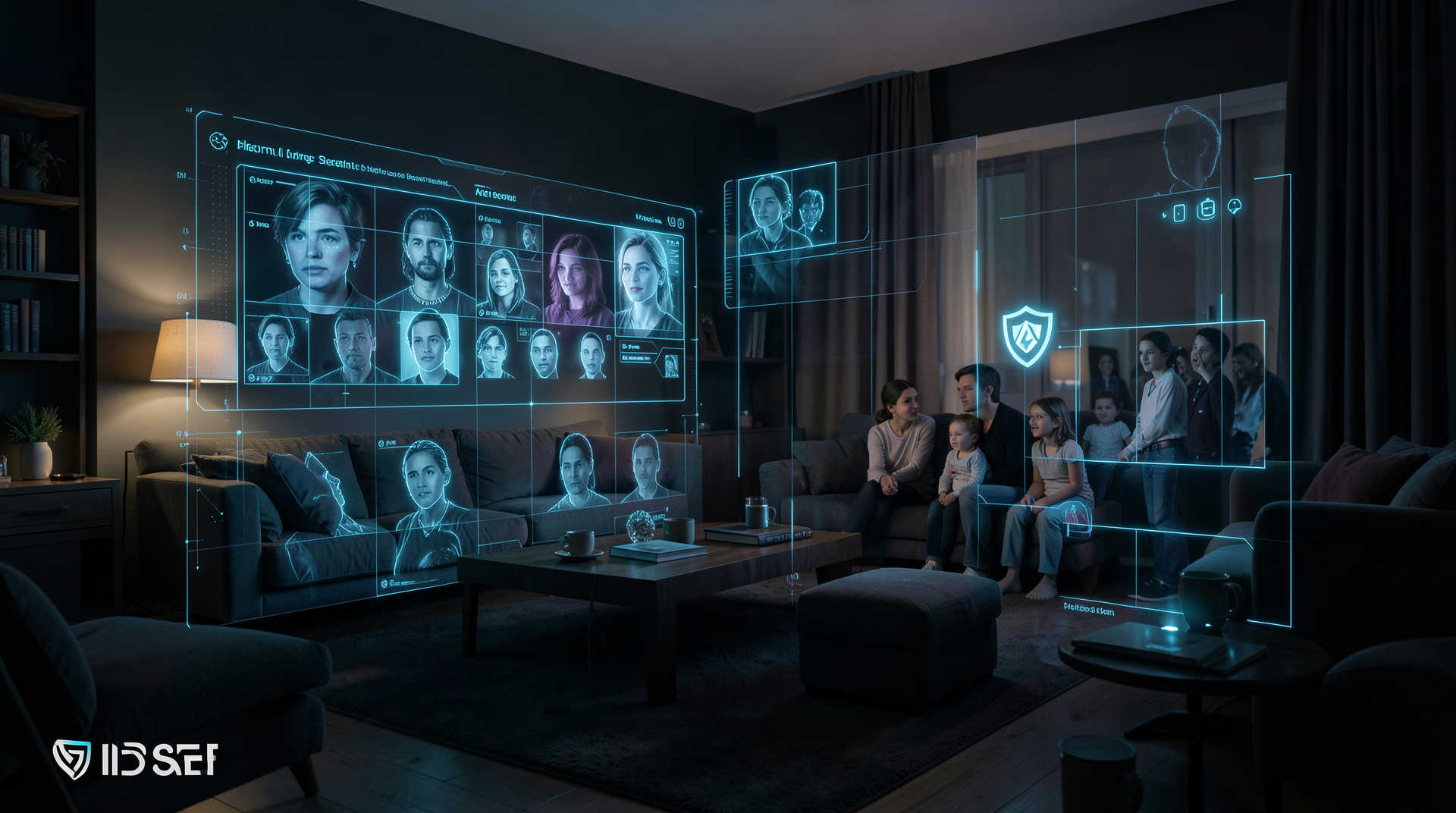
Smart home security cameras have a dirty secret: most of them are sending video of your home to someone else's server. Every time your doorbell camera detects motion, that footage travels through the cloud — through infrastructure you don't control, subject to policies you didn't read, vulnerable to breaches you can't prevent. It doesn't have to be this way.
Advances in edge AI hardware have made it possible to run sophisticated computer vision models entirely on-device. With an NVIDIA Jetson Orin Nano sitting on your home network, you can build a security system that detects people, vehicles, and packages, recognizes familiar faces, and flags anomalous behavior — all without a single frame leaving your home.
The Privacy Problem with Cloud Surveillance
Cloud-based security cameras dominate for one reason: they were the only practical option. Local NVRs could store footage, but they couldn't analyze it. Cloud cameras offered notifications — "Person detected at front door" — but that convenience came at a cost. Ring gave law enforcement doorbell footage without warrants. Nest cameras were found to have hidden microphones. The 2021 Verkada breach exposed 150,000 live feeds from hospitals and schools. There's a fundamental question: why should footage of your private life be stored on infrastructure you don't control?
How Edge AI Security Actually Works
Setting up local AI surveillance sounds complex, but modern tooling makes it surprisingly accessible. Here's the high-level architecture of a cloud-free security system:
- Cameras feed RTSP or ONVIF streams to a central edge device — typically an NVIDIA Jetson Orin Nano running at 15W power draw
- AI models process each frame using optimized computer vision pipelines: YOLOv8 or EfficientDet for object detection, FaceNet or ArcFace for facial recognition
- Inference results trigger actions locally: push notifications via MQTT, recording clips to local storage, activating smart lights, or sounding an alarm — all without cloud round-trips
- Dashboards and NVR software like Frigate or Scrypted provide a polished UI to review events, manage zones, and tune detection sensitivity
The key enabler is the Jetson Orin Nano's dedicated AI accelerator. With 40 TOPS of INT8 performance, it runs multiple simultaneous detection streams — you could process eight 1080p camera feeds at 30 FPS each with headroom to spare. The same task would require a full desktop GPU and consume 10x the power.
Three AI Capabilities That Change Home Security
Real-Time Object Detection
Object detection is the foundation of modern security. The AI draws bounding boxes around people, vehicles, animals, and packages in real time. Unlike pixel-based motion detection — which triggers on a leaf or a shadow — AI detection only alerts you when something relevant appears. Models like YOLOv8 nano run at under 15ms per frame on the Jetson Orin Nano, and zone-based filtering lets you restrict alerts to specific areas: your front door, not the public sidewalk.
Facial Recognition for Trusted Individuals
You can enroll family members and regular visitors, and the system greets them by name while filtering them from alerts. FaceNet embeddings generated on-device achieve over 99% accuracy on known faces for galleries of hundreds of people. Unknown faces trigger heightened alerts. The entire pipeline runs locally — no facial data ever leaves your network.
Anomaly Detection and Behavior Analysis
Advanced edge AI detects not just what is in a scene, but what's unusual about it. Using lightweight temporal models and pose estimation, the system identifies behaviors: someone loitering at 2 AM, a person running across the yard, or a vehicle idling in the driveway. Some implementations use vision transformers on TensorRT to classify anomalies with 95%+ accuracy in under 50ms.
Cloud vs. Local AI: The Real Comparison
| Feature | Cloud Security Camera | Edge AI (Jetson Orin Nano) |
|---|---|---|
| Video processing | Uploaded to cloud servers | Processed on-device |
| Privacy | Third-party data storage | 100% local, no data leaves home |
| Monthly fees | $3 – $20+/mo per camera | $0 after hardware purchase |
| Detection latency | 500ms – 2000ms (cloud round-trip) | <15ms (on-device) |
| Offline reliability | Disabled during internet outage | Full functionality offline |
| AI capabilities | Limited to vendor's models | Any model, fully customizable |
| Storage control | Vendor's cloud (limited retention) | Your own NAS or local storage |
Building Your Own Cloud-Free Security System
Getting started doesn't require a PhD. Here's a practical path:
- Hardware: An NVIDIA Jetson Orin Nano (Developer Kit from ~$250) with an NVMe SSD. Power draw is 7W–15W — less than a light bulb.
- Cameras: Any ONVIF-compatible IP camera. Reolink, Dahua, and Amcrest work well. A single Jetson handles 6–8 cameras.
- Software: Frigate is the leading open-source NVR with AI detection. It integrates with Home Assistant and supports Jetson acceleration.
- Notifications: Push alerts through your own Home Assistant server. No cloud relay, no subscription, no third party.
For those who'd rather not build from scratch, the NexLine platform brings it all together as a pre-configured appliance — Jetson Orin Nano running Frigate, Home Assistant, and custom models, ready to plug in.
The Bottom Line
The era of cloud-dependent home security is ending. Edge AI hardware has crossed the threshold where running state-of-the-art computer vision models on a $250 device is not just possible — it's practical, power-efficient, and in many cases more capable than cloud alternatives. You get faster detection, absolute privacy, zero monthly costs, and a system that works when your internet goes down.
The question used to be: "Can I afford the privacy cost of a cloud security camera?" The better question now is: "Why would I accept it?"
Frequently Asked Questions
Can AI-powered home security work without the cloud?
Yes. Edge AI security systems process all video analytics locally on hardware like the NVIDIA Jetson Orin Nano. Object detection, face recognition, and anomaly detection happen on-device. No video footage ever leaves your home network — not even for processing.
How accurate is local AI compared to cloud-based detection?
Modern edge AI models like YOLOv8 and EfficientDet achieve 99.5%+ accuracy for object detection on the Jetson Orin Nano — matching or exceeding cloud-based services. Face recognition with FaceNet reaches over 99% on enrolled individuals. The difference is that cloud services send your video to a remote GPU, while edge AI does the same computation on your desk.
How many cameras can a single Jetson Orin Nano handle?
A Jetson Orin Nano can process 6–8 simultaneous 1080p camera streams at 30 FPS with real-time object detection on each stream. With lower resolutions or optimized models, you can push that to 12+ streams. The 40 TOPS AI accelerator is remarkably efficient for multi-stream surveillance workloads.
What happens to my footage during an internet outage?
Everything keeps working. Because all detection and recording happens locally, an internet outage has zero impact on your security system. Alerts, recordings, and live viewing all continue normally. The only thing that stops is remote access from outside your home — which can be restored via a local VPN like WireGuard.
Is edge AI security difficult to set up?
It depends on your comfort level. For DIY enthusiasts, Frigate + Home Assistant + a Jetson Orin Nano can be set up in an afternoon. For those who prefer a plug-and-play experience, pre-configured appliances like the NexLine security stack come ready to run — just connect cameras and configure detection zones through a web interface.
Edge hardware: Google Coral and NVIDIA Jetson Orin Nano benchmarks for on-device computer vision
Privacy-first approach: The NexLine architecture applies the same local-only principle to voice and home automation — a complete edge AI pipeline with zero cloud dependency.