Most DIY voice control projects are built on Raspberry Pis. And if you've tried one, you know why they don't work well: a Raspberry Pi doesn't have enough AI horsepower to run modern voice models locally.
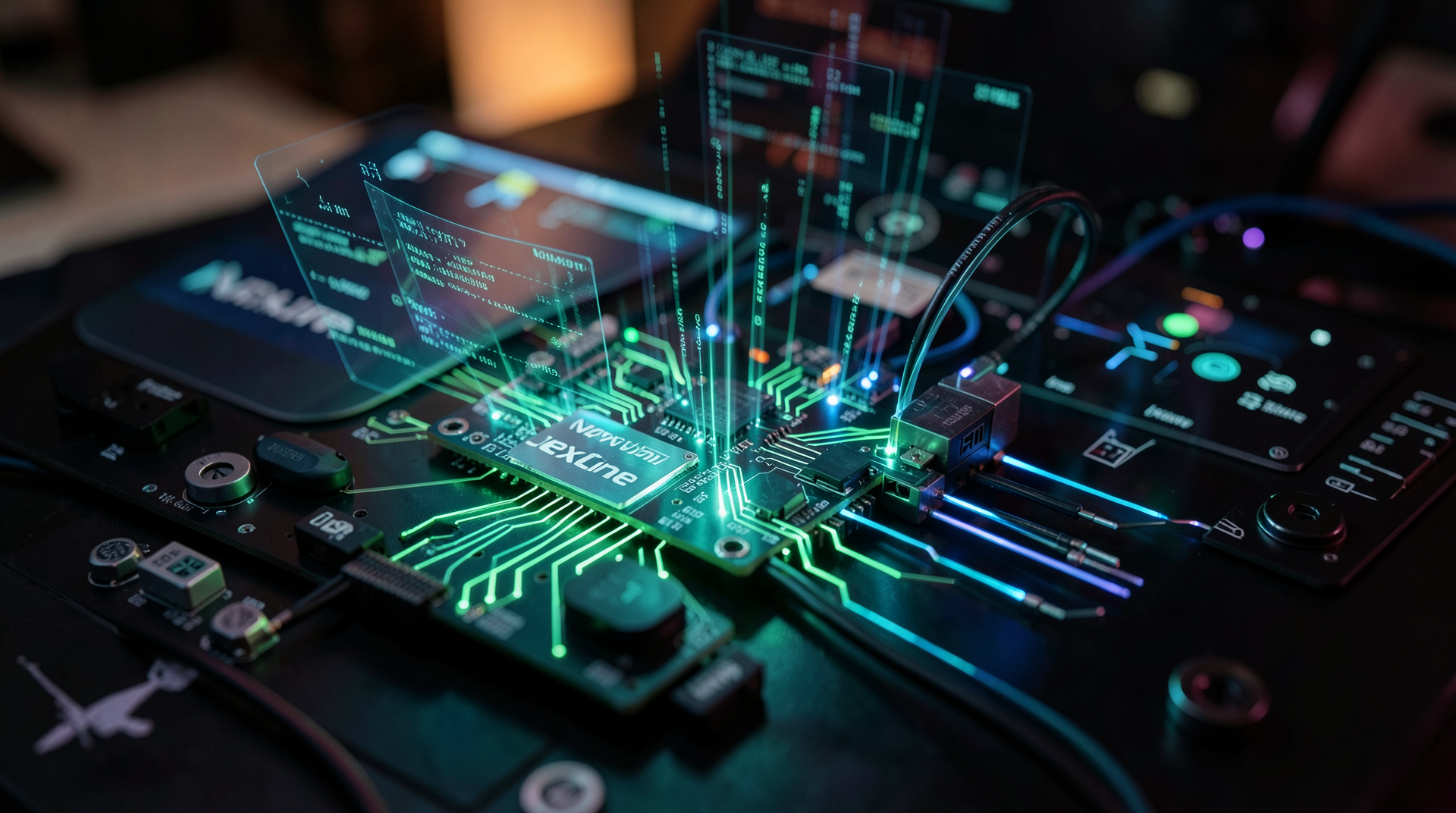
Enter the NVIDIA Jetson Orin Nano — a single-board computer designed specifically for edge AI. It's the processor inside the NexLine Voice Box.
What Is the Jetson Orin Nano?
NVIDIA's entry-level edge AI module. Here's what's under the hood:
40 TOPS means 40 trillion AI operations per second — enough to run Whisper, Kokoro, and a 3B-parameter LLM simultaneously with headroom.
Why the Raspberry Pi Falls Short
The gap isn't subtle. Here's how the two single-board computers compare for voice AI workloads:
| Task | Raspberry Pi 5 | Jetson Orin Nano |
|---|---|---|
| GPU cores | 16 (VideoCore VII) | 1024 (Ampere) + 32 Tensor Cores |
| AI TOPS | <1 | 40 |
| Whisper inference | 8–12 seconds | 0.3–0.8 seconds |
| Kokoro TTS | 3–5 seconds | 0.1–0.3 seconds |
| Local LLM (3B) | Not feasible | 15–25 tokens/sec |
That Whisper inference time is the killer. On Pi: wait 8–12 seconds just for STT. On Jetson: sub-second. Changes the experience from "cool demo" to "actually useful."
With the Jetson Orin Nano: sub-second responses, local LLM integration, beamforming + noise suppression, and pre-built NVIDIA containers that just work.
Why Tensor Cores Matter
Running Models on Jetson
Here's what you can expect in terms of real-world performance and VRAM usage:
| Model | Inference Time | VRAM Usage |
|---|---|---|
| Whisper Tiny | ~150ms | ~500 MB |
| Whisper Base | ~350ms | ~1 GB |
| Whisper Small | ~800ms | ~2 GB |
| Kokoro TTS | 100–300ms / phrase | ~500 MB |
| Qwen 3B LLM | 20–30 tokens/sec | ~3 GB |
| Llama 3.2 8B | 8–12 tokens/sec | ~6 GB |
NexLine defaults to Whisper Base — the sweet spot between accuracy (~96% WER) and speed (~350ms). For the LLM pipeline, Qwen 3B delivers quality responses at 20–30 tokens/sec with plenty of headroom for simultaneous voice processing.
Power Consumption: Less Than a Light Bulb
One of the most impressive things about the Orin Nano is how little power it uses given what it delivers:
- Idle: ~3W
- Light load: ~5W
- Active (voice processing): ~10W
- Max (full AI load): ~15W
For comparison, a standard LED bulb draws 8–12W. The Jetson Orin Nano does all its AI processing within that same power envelope. In the NexLine enclosure, it's passively cooled — no fan noise, no moving parts, just silent operation 24/7.
Future-Proofing
The Orin Nano isn't a dead end. NVIDIA's modular ecosystem means you have a clear upgrade path:
- Same carrier board: Swap the Orin Nano module for an Orin NX module (up to 100 TOPS) without replacing the entire device.
- Software improvements: NVIDIA's JetPack SDK regularly delivers performance optimizations — newer releases often yield 10–20% faster inference for the same models.
- Model evolution: As Whisper v3+ and smaller LLMs emerge, the Orin Nano's 40 TOPS and 8GB RAM handle them comfortably.
For a deeper look at how local voice AI compares to the big cloud players, read our comparison article: Alexa vs Google Home vs Local Voice Control.
Frequently Asked Questions
Is the Jetson Orin Nano better than Raspberry Pi for voice AI?
Yes — by a wide margin. For voice AI workloads, the Jetson Orin Nano delivers 40 TOPS of AI performance vs the Raspberry Pi 5's less than 1 TOPS. Whisper speech-to-text runs in 0.3–0.8 seconds instead of 8–12 seconds, and you can run local LLMs that simply aren't feasible on a Pi.
What AI models can the Jetson Orin Nano run locally?
The Orin Nano easily runs Whisper (Tiny/Base/Small), Kokoro TTS, and smaller LLMs like Qwen 3B at 20–30 tokens/sec. The 8GB module can even run Llama 3.2 8B at 8–12 tokens/sec. All models can run simultaneously with enough headroom for real-time voice interaction.
Does the Jetson Orin Nano work offline?
Absolutely. All AI processing — speech-to-text, text-to-speech, and LLM inference — happens entirely on-device using the Jetson's GPU and Tensor Cores. No internet connection is required for voice commands. Your smart home stays responsive even during internet outages.
How much power does the Jetson Orin Nano use?
Idle: ~3W. Light load: ~5W. Active voice processing: ~10W. Maximum under full AI load: ~15W. That's less than a standard LED light bulb. In the NexLine enclosure, it's passively cooled with zero fan noise.
Can I upgrade the Jetson Orin Nano later?
Yes. The Orin Nano uses NVIDIA's modular MXM form factor. You can swap it for an Orin NX module (up to 100 TOPS) on the same carrier board — no need to replace the entire device. Plus, NVIDIA's JetPack SDK keeps getting faster with each release.
Local LLM on Jetson: Qwen 2.5 3B and Llama 3.2 3B — ~45 tok/sec on Jetson Orin Nano with 4-bit quantization
Production implementation: The NexLine Voice Box runs the full stack — Whisper + ChromaDB + Qwen 3B on a Jetson Orin Nano — for local-first smart home AI.